
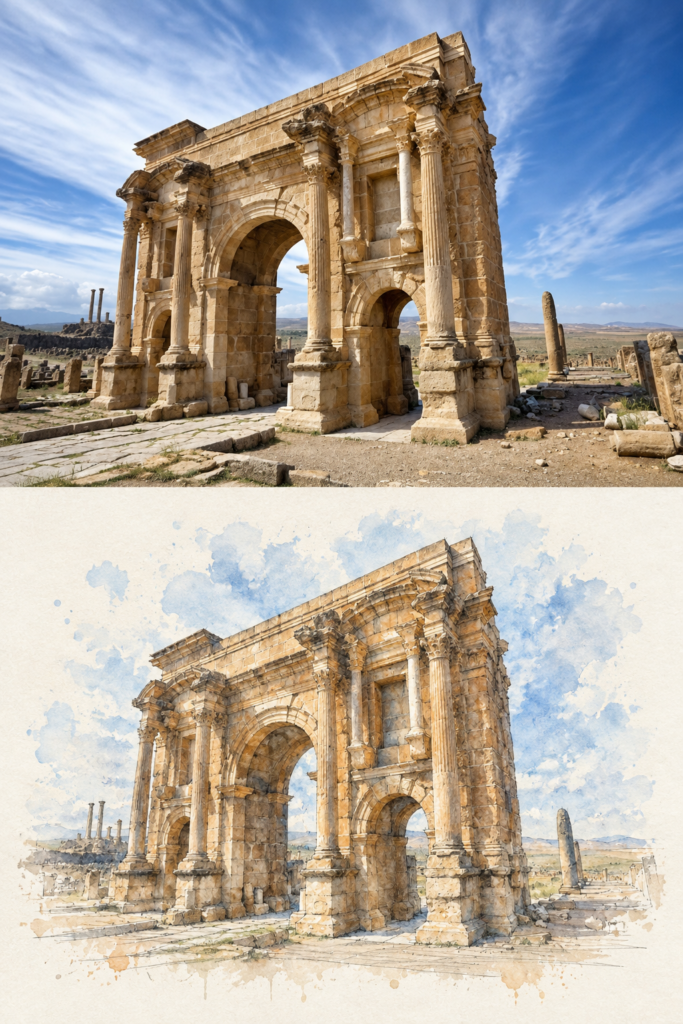
Echoes of Eternity; A Roman Legacy in Watercolor.
Prompt
Create a premium, professional before-and-after fine-art image composition using the uploaded photograph as the only visual reference.
COMPOSITION — ORIGINAL PHOTO ABOVE, ARTWORK BELOW
Create a vertically stacked, two-part composition in a 2:3 portrait format.
TOP SECTION — ORIGINAL PHOTOGRAPH (50%)
Display the original uploaded photograph exactly as it is, occupying the entire upper half of the canvas.
IMPORTANT:
Preserve the original photograph completely and faithfully. Do not apply any filters, artistic effects, color grading, retouching, or alterations. Do not redraw, regenerate, crop, distort, or replace the original image. Preserve its original colors, lighting, perspective, composition, textures, and every visible detail. The upper section must remain a faithful, untouched copy of the uploaded photograph.
BOTTOM SECTION — INK & WATERCOLOR ARTWORK (50%)
Directly below the original photograph, create an artistic ink-and-watercolor interpretation of the SAME scene.
Use the uploaded photograph as the exclusive reference for the lower illustration.
Preserve the original subject's recognizable identity, architecture, proportions, perspective, structural details, and surrounding environment.
Transform the photograph into an elegant, hand-painted illustration featuring:
Fine, delicate black ink outlines and expressive architectural sketching. Translucent watercolor washes with natural pigment bleeding and subtle granulation. Soft pencil-like contours, intricate hand-drawn details, and gentle shading. Muted, sophisticated colors inspired by the original photograph. Warm ochre, sandstone beige, earthy brown, delicate gray, and pale blue watercolor pigments where appropriate. Organic brush textures and subtle imperfections characteristic of traditional watercolor on paper. SIGNATURE FADING EFFECT
Reproduce the delicate, dissolving watercolor aesthetic of contemporary architectural concept art.
Keep the upper portion of the lower illustration detailed, recognizable, and faithful to the original photograph.
As the artwork approaches its bottom edge, gradually dissolve the scene into:
Pale, translucent watercolor washes. Loose, fragmented ink strokes. Delicate pencil marks and architectural sketch lines. Soft pigment splashes and irregular watercolor edges. Fine horizontal lines that extend naturally across the paper. Faint, unfinished details that gently disappear into the background.
Allow the lower edges of the subject and surrounding environment to dissolve organically into a clean, warm-white or ivory paper background.
The fading effect must feel artistic, natural, and hand-painted rather than digitally glitched.
TRANSITION & LAYOUT
Separate the two sections with a clean, straight horizontal division.
The original photograph must remain visually independent from the watercolor artwork.
The lower illustration should resemble a faithful artistic reinterpretation of the photograph above, not a different scene.
Maintain consistent subject placement and visual alignment between the two sections wherever possible.
Use a minimal, elegant layout with generous negative space, refined proportions, and no unnecessary decorative elements.
FINAL QUALITY
Professional fine-art photography and illustration presentation, traditional ink-and-watercolor technique, elegant architectural concept art, delicate sketchbook aesthetics, realistic watercolor textures, high-resolution details, sophisticated editorial composition.
ABSOLUTE PRIORITY: The top half must remain the original, untouched photograph. Only the bottom half should be transformed into the ink-and-watercolor illustration.
No text, captions, logos, borders, watermarks, or additional subjects.
Aspect ratio: 2:3 portrait.