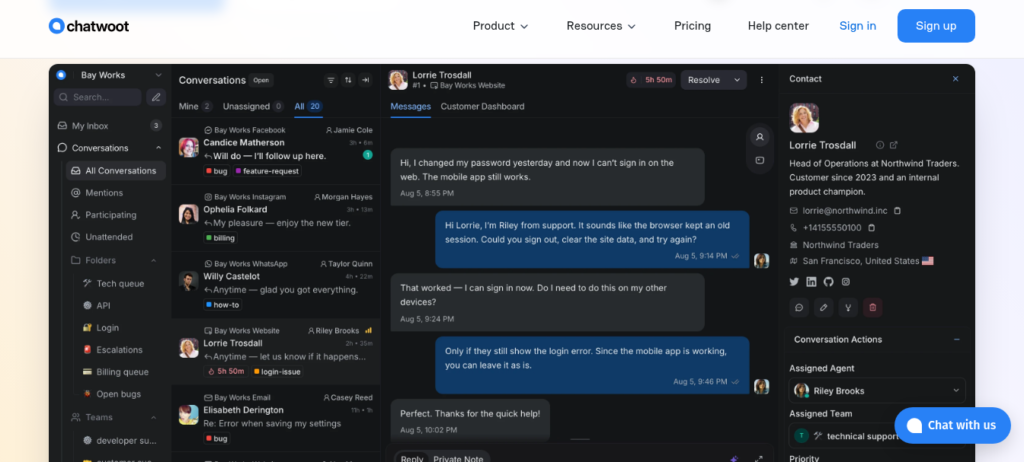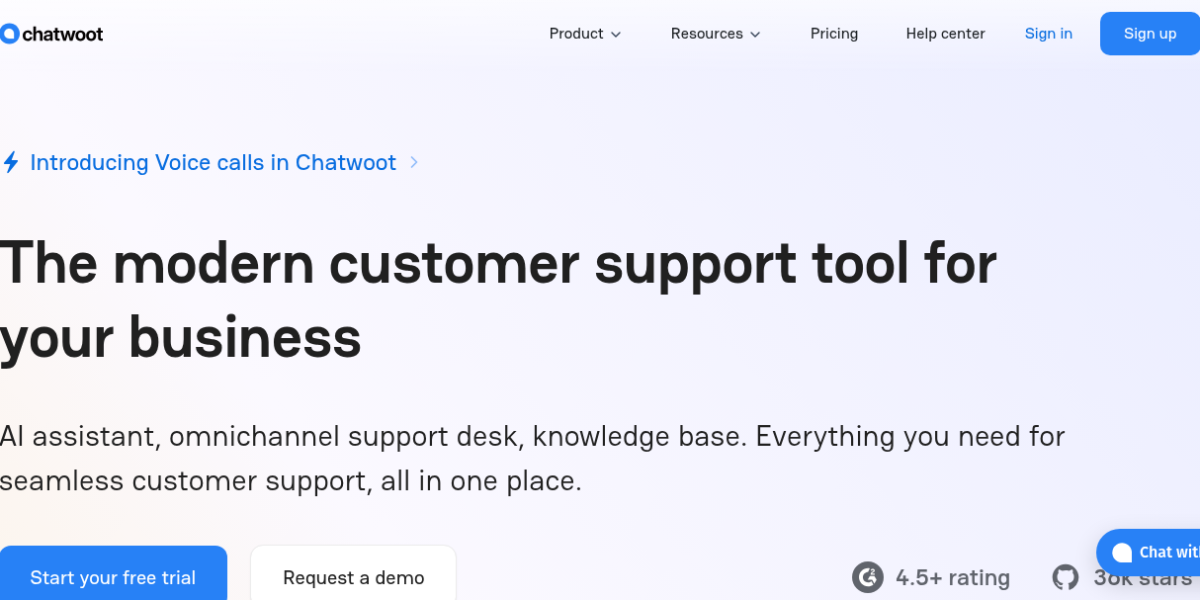
Chatwoot is an open-source customer engagement platform for support and sales teams. It unifies live chat, email, WhatsApp, Instagram, and voice into one shared inbox. Moreover, it offers a built-in AI agent, help center, and automation rules for growing teams. As a result, it is a strong self-hostable alternative to Intercom and Zendesk for teams that want to own their support data in 2026.
Key Features
Chatwoot has a full omnichannel support stack for teams of any size. First, it consolidates live chat, email, WhatsApp, Instagram, TikTok, Telegram, LINE, and SMS into one shared inbox. Second, it adds Captain AI, its built-in assistant that drafts replies, summarizes conversations, and answers customers from your help center automatically. Then, it offers automation rules, team-based routing, and business hours to keep conversations organized. In addition, it ships a self-serve help center so customers can find answers without waiting on an agent. Furthermore, it provides conversation, agent, and CSAT reporting to track team performance. Plus, because it’s open-source, teams can self-host it on their own infrastructure instead of Chatwoot’s cloud. So it fits both budget-conscious startups and engineering-forward teams that want full control over their data.
Pricing Plans
Chatwoot uses tiered per-agent pricing with a permanent free plan. The Hacker plan is free for up to 2 agents with 500 conversations per month and 30-day data retention. The Startups plan is $19 per agent/month (billed annually) with unlimited conversations and 300 Captain AI credits. The Business plan is $39 per agent/month with 500 AI credits, automation, and voice support. The Enterprise plan is $99 per agent/month with 800 AI credits, SSO, and audit logs. Extra Captain AI credits cost $20 per 1,000 on any paid plan.
Who Uses Chatwoot?
Chatwoot fits support teams, startups, and engineering-led companies. For instance, a startup can run its entire support inbox on the free Hacker plan before it needs to pay. Similarly, a SaaS company can route WhatsApp and email into one shared inbox with automation rules. In contrast, a large enterprise with strict compliance needs may prefer self-hosting for full data control. But a scaling support team can use Captain AI to cut first-response time without hiring more agents. So it fits teams that want omnichannel support without vendor lock-in.
How Chatwoot Compares
Chatwoot wins on cost and data ownership against closed-source competitors. First, it offers a self-hosted, open-source option, while Intercom is cloud-only with no self-hosting path — see our full Intercom review for a closer look at that platform. Second, its Business tier undercuts most closed-source competitors on a per-agent basis. However, Intercom offers a more mature AI product and deeper native integrations that Chatwoot is still catching up to. Also, Zendesk provides more advanced enterprise workflow tooling that smaller Chatwoot teams may not need. Explore our full directory or read our v0 review for UI generation. For updates, visit Chatwoot-tool.
Best For
Chatwoot fits support and sales teams that want an affordable, self-hostable alternative to Intercom or Zendesk. It offers an omnichannel inbox, built-in AI, help center, and automation, with a genuine free tier and full source-code ownership for teams that need it.