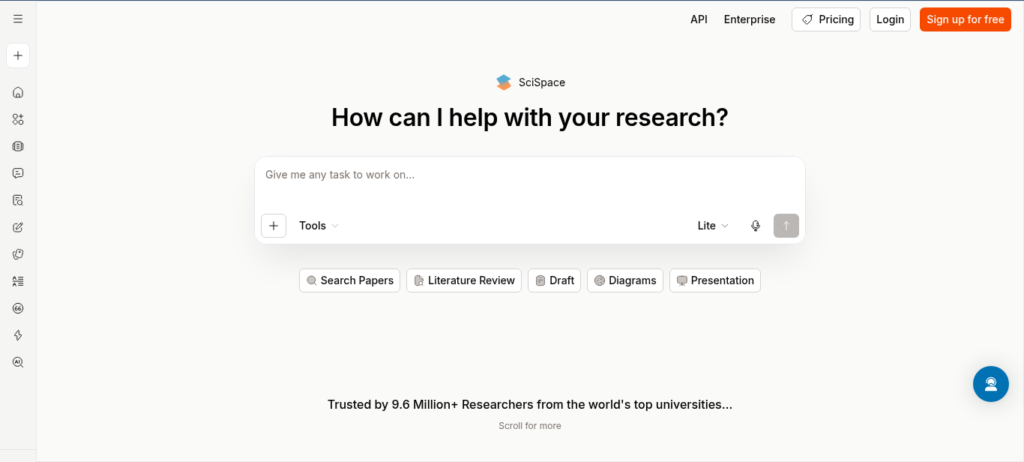
SciSpace is an AI research assistant for academics and students. It reads, summarizes, and cites papers from a corpus of 280 million sources. Moreover, it offers Deep Review for literature searches and an AI Writer for drafting. As a result, it is a top choice for researchers who want one tool for the whole workflow in 2026.
Key Features
SciSpace has a full research stack for academics. First, it chats with PDFs to explain text, tables, and equations in plain language. Second, it generates literature reviews by analyzing dozens of papers at once. Then, it creates citations in over 9,000 styles with one click. In addition, it offers Deep Review for high-precision topic searches across millions of papers. Furthermore, it has an AI Writer that drafts and paraphrases with source tracking. Plus, it supports 75 languages for global researchers. So it fits PhD candidates, scientists, and students who need fast paper comprehension.
Pricing Plans
SciSpace has four tiers based on credits and features. The Free plan is $0 per month with 100 credits and basic PDF chat. The Premium plan is $20 per month with 1,200 credits and unlimited downloads. The Advanced plan is $90 per month with 10,000 credits and Deep Review. The Max plan is $200 per month with 40,000 credits for heavy research. So users can start free and scale with project needs.
Who Uses SciSpace?
SciSpace fits researchers and students across fields. For instance, a PhD candidate can review 50 papers for a literature review in one afternoon. Similarly, a biologist can explain complex equations and tables from a PDF in plain language. In contrast, a casual reader with one paper may not need the full platform. But grant writers can draft proposals with cited sources automatically. So it fits academics, scientists, and graduate students.
How SciSpace Compares
SciSpace wins on all-in-one research depth and citation breadth. First, it has 280 million papers in its corpus, which Perplexity lacks for academic depth. Second, it offers 9,000 citation styles, while Consensus has fewer formatting options. However, Perplexity is better for real-time web research with current events. Also, Elicit is stronger for systematic review extraction. Explore our full directory or read our Julius AI review for data analysis. For updates, visit SciSpace-Ai
Best For
SciSpace fits researchers and students who need an AI assistant for reading papers, generating literature reviews, and creating citations. It offers PDF chat, Deep Review, and an AI Writer with source tracking for academic workflows.