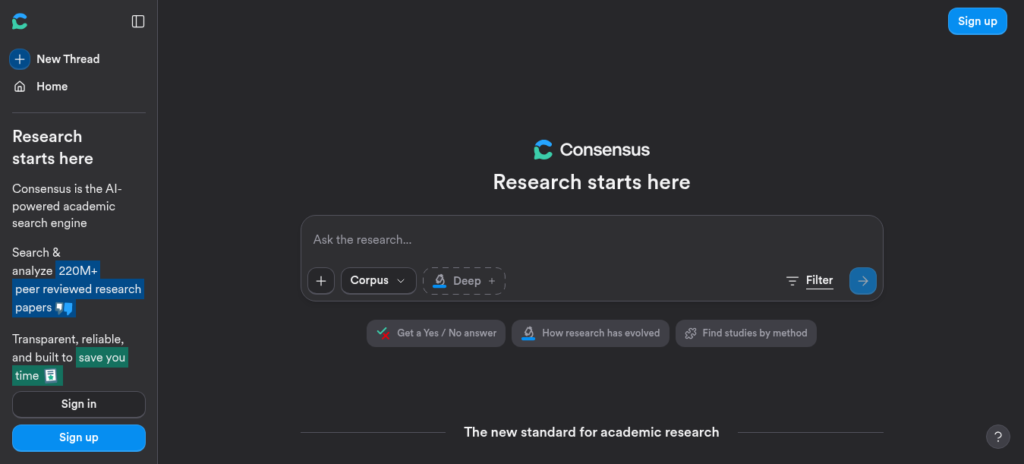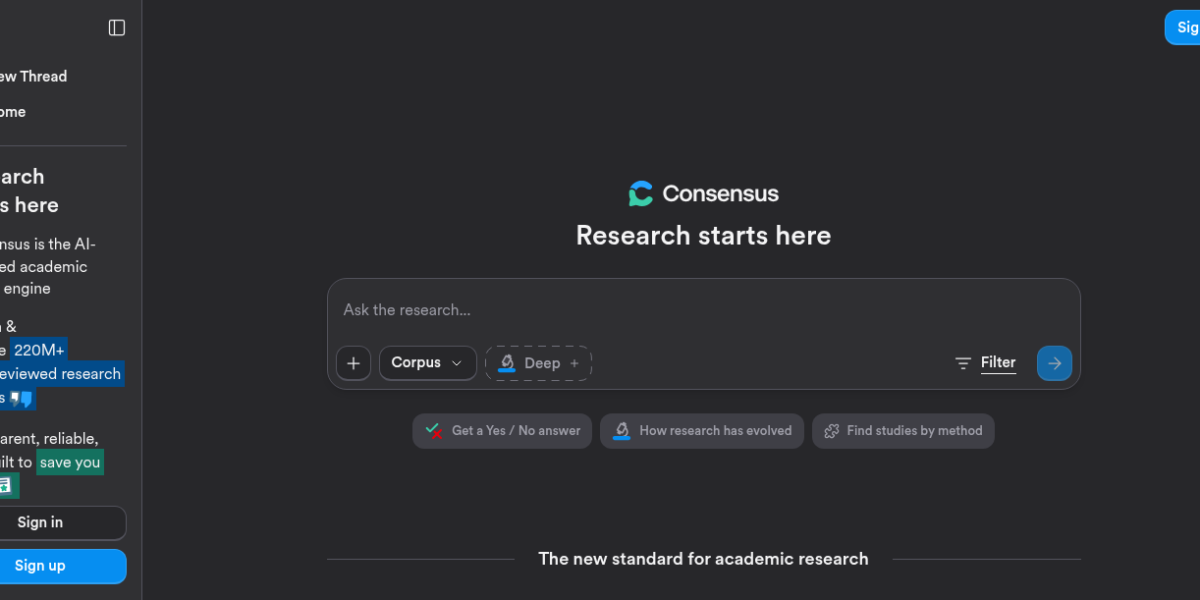
Consensus is an AI-powered academic search engine for researchers and students. Because manual literature reviews are slow, it searches over 200 million peer-reviewed papers and synthesizes evidence-based answers with citations. Moreover, it offers a Consensus Meter that visualizes where the research leans on a given question. As a result, it is a strong choice for literature reviews and evidence-based research in 2026.
Key Features
Consensus has a full research stack for academics and clinicians. First, it searches a corpus of over 200 million peer-reviewed papers, including 8 million+ medical papers. Second, it offers three search modes: Quick Search for a fast overview, Pro Search to surface key papers, and Deep Search for higher-precision, AI-assisted report generation. Because depth needs vary by task, users can switch modes freely. Then, it generates Study Snapshots that break a paper down by population, sample size, and methods. In addition, it cites every claim in its summaries directly to the source paper, sentence by sentence, so nothing is left unverifiable. Furthermore, it offers a Consensus Meter that shows at a glance whether the literature agrees, disagrees, or is mixed. Plus, it integrates with ChatGPT and exposes an API/MCP endpoint for developers. Therefore, it fits anyone who needs fast, evidence-backed answers instead of a manual literature search.
Pricing Plans
Consensus uses freemium pricing with a genuinely usable free tier. Because the free plan includes unlimited Papers searches, limited Pro messages, 3 Deep reviews, and 10 Study Snapshots per month, casual users rarely need to upgrade. However, the Pro plan is $20 per month, or $12 per month billed annually, for unlimited Pro searches and 15 Deep searches. Similarly, the Deep plan is $65 per month, or $45 per month billed annually, with 200 Deep searches for power users. For example, a research lab that needs more than 200 seats would instead choose the Teams plan, which offers custom per-seat discounts, while Enterprise stays quote-based for organizations over 200 users.
Who Uses Consensus?
Consensus fits students, researchers, and clinicians. For instance, a grad student can scope a literature review in minutes instead of days. Similarly, a clinician can pull evidence-based answers from medical literature during research. However, someone doing a formal systematic review may find it too fast and loose for a fully repeatable, transparent search. Meanwhile, a university department can equip an entire lab through the Teams plan. Because of this range, it fits people who need a fast, cited starting point more than an exhaustive database query.
How Consensus Compares
Consensus wins on citation transparency for academic search. First, it grounds every summary in real peer-reviewed papers, while a general chatbot like ChatGPT can fabricate sources. Second, it offers a purpose-built Consensus Meter that traditional databases like PubMed do not provide. However, tools like SciSpace and Elicit cover similar ground and may suit different workflows better. Also, Consensus is not a replacement for Boolean search in library databases when a review must be fully repeatable. Explore our full directory or read our Chatwoot review for support tools. For updates, visit ConsensusApp.
Best For
Consensus fits students, researchers, and clinicians who need fast, cited answers from peer-reviewed literature. Because it offers three search depths, Study Snapshots, and a visual Consensus Meter, it works equally well for a quick scoping search or a deeper review. Therefore, its genuinely usable free plan makes it easy to try before committing to Pro or Deep.